Counter-Drone Legal and Regulatory Considerations
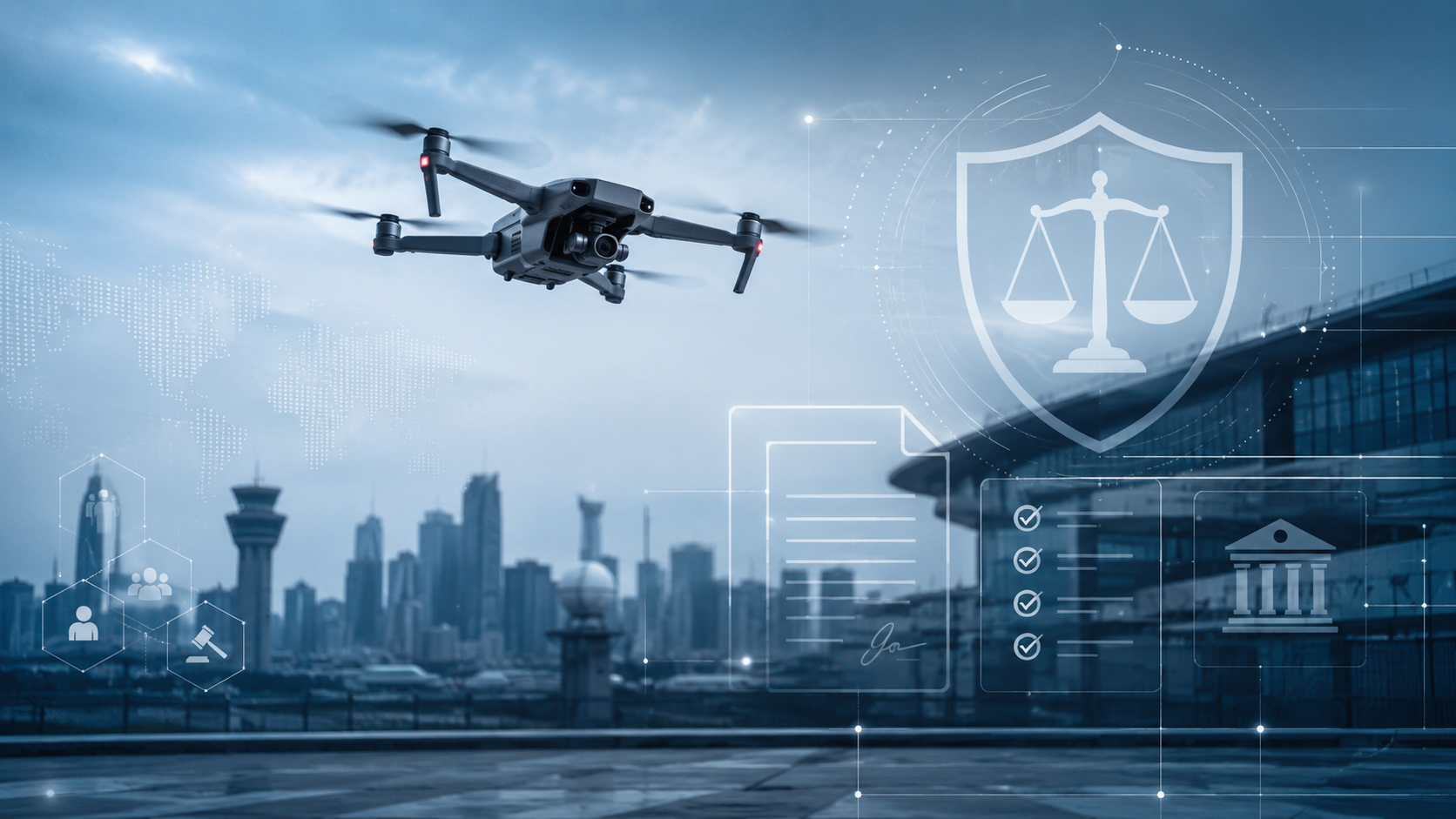
Understanding Legal Authority Before Technology Investment
Counter-drone capability can involve a broad range of technologies, from passive detection and monitoring through to active disruption, interception or physical response.
While many organisations are becoming increasingly aware of drone-related risk, the legal and regulatory environment surrounding counter-drone capability is complex. Technology selection should not be based on product capability alone. It should also consider legal authority, aviation safety, privacy, communications regulation, operational governance and proportionality.
Counter Drone Solutions provides independent advisory support to help organisations understand the legal and operational considerations that should be assessed before acquiring, deploying or using counter-drone capability. Counter Drone Solutions does not provide legal advice. Organisations should obtain independent legal and regulatory advice before implementing counter-drone detection, disruption or response capability.
Detection Versus Mitigation
A key legal and operational distinction exists between detection and mitigation.
Detection technologies may include:
• RF detection,
• Radar,
• Optical or thermal cameras,
• Remote ID receivers,
• Acoustic sensors, and
• Command-and-control software.
These systems are generally used to detect, track, classify, confirm or record drone activity.
Mitigation or response technologies may include:
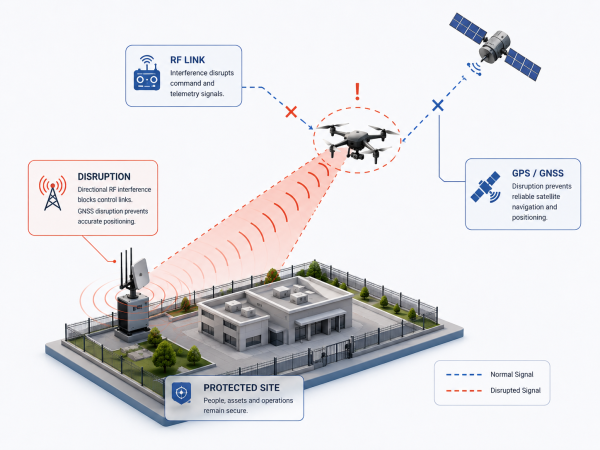
• RF disruption,
• GNSS/GPS disruption,
• Protocol manipulation,
• kinetic capture,
• Interceptor drones,
• Projectile-based capture, and
• Other physical or electronic defeat methods.
Mitigation technologies are generally more legally sensitive because they may interfere with the drone, pilot, control signal, navigation system, airspace safety, property or evidence.
For many commercial and private organisations, detection, reporting, escalation and coordination with authorised agencies may be more appropriate than active mitigation.
RF and GPS Jamming
In Australia, jamming devices are highly restricted. The Australian Communications and Media Authority states that mobile phone jammers, GPS jammers, Wi-Fi jammers and drone jammers are illegal in Australia, with large fines and/or prison sentences applying to possession, supply or operation of these devices.
Organisations should therefore be extremely cautious when considering any technology that disrupts, blocks, interferes with or transmits against drone communication, control, telemetry or navigation systems.
Interfering with a Drone
Active interference with a drone may create aviation safety and legal risks.
CASA states that interfering with a drone, or operating a drone in a way that becomes a hazard to other aircraft, can result in imprisonment for up to two years. CASA also notes that states and territories may have additional laws and penalties that apply.
This is relevant because some counter-drone response methods may cause a drone to:
• Lose control,
• Descend unexpectedly,
• Crash,
• Enter another airspace area,
• Create a hazard to people or property, or
• Interfere with other aviation activity.
Any active response capability should therefore be assessed against aviation safety, legal authority, public safety, proportionality, evidence handling and liability considerations.
Kinetic and Physical Response Systems
Kinetic counter-drone systems involve the physical interception, capture, damage or disabling of a drone. This may include net capture systems, interceptor drones, projectile-based capture systems or other physical response methods.
These systems may avoid some RF or GNSS interference issues, but they introduce other legal and operational risks. Operational use should consider:
• Authority to engage or capture the drone,
• Aviation safety obligations,
• Risk to people, property and infrastructure,
• Potential damage to the drone or payload,
• Preservation of evidence,
• Post-capture handling procedures,
• Workplace health and safety requirements,
• Public liability and insurance implications,
• Operator training and competency, and
• Coordination with law enforcement or other authorised agencies.
Kinetic response capability should generally be considered as one part of a broader layered counter-drone approach, not as a standalone solution.