
RF Drone Detection Capability
Radio Frequency Awareness within a Layered Counter-Drone Approach
Technology Considerations
The technologies referenced on this page are representative examples of RF drone detection capability approaches currently available within the market. Counter Drone Solutions does not advocate a single technology, manufacturer or sensor approach. Capability selection should be based on operational requirements, environmental conditions, legal considerations and validated threat assessment outcomes.

Radio Frequency (RF)
RF drone detection refers to the use of radio frequency monitoring technology to detect, identify, classify or locate drone activity based on signals transmitted between a drone, controller or associated communication system.
RF detection is one of the most common layers used in counter-drone capability because many drones rely on radio frequency communication for command, control, telemetry, video transmission or remote identification.
Counter Drone Solutions provides independent advice on where RF drone detection may fit within a broader counter-drone strategy, including operational suitability, limitations, integration considerations and layered detection planning.
Where RF Detection Fits
RF detection is often used as an early warning and situational awareness layer within a counter-drone system. Depending on the technology, configuration and operating environment, RF detection may assist operators to:
• Detect drone control or telemetry signals,
• Identify known drone types or manufacturers,
• Detect controller activity,
• Estimate direction or location of drone activity,
• Support operator awareness,
• Assist with activity logging and reporting,
• Provide alerts before visual confirmation is possible, and
• Support broader layered detection workflows.
RF detection can be particularly useful where an organisation needs to understand whether drone activity is occurring around a site before committing to more complex or expensive counter-drone capability.
Types of RF Drone Detection Capability
Protocol-Based RF Detection
Protocol-based RF systems detect drones by recognising known communication protocols, signal characteristics or manufacturer ecosystems. They may provide information such as drone type, manufacturer, signal strength, controller location, drone location, telemetry, flight path data and activity history, where supported. Capability may vary depending on drone type, firmware, encryption, operating mode and software support.
RF Spectrum Monitoring
RF spectrum monitoring systems observe selected radio frequency bands to identify signals that may be associated with drone activity. They can assist with detecting unknown or non-standard signals, understanding RF congestion and informing future capability design. These systems may provide broader awareness but can require more analysis, tuning and operator interpretation.
Direction Finding and Triangulation
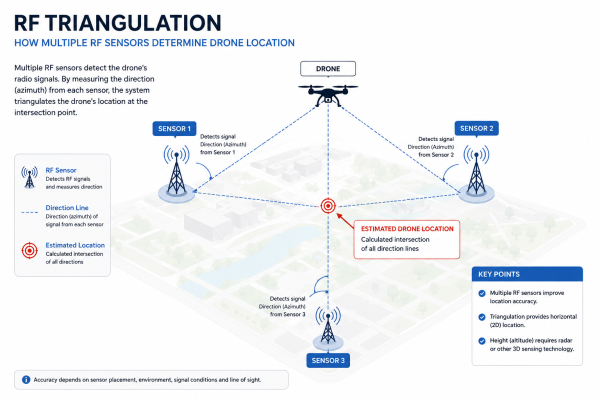
Some RF systems use multiple sensors to estimate the direction or location of a drone or controller. This may assist with locating the operator, improving response planning, identifying repeated activity patterns and supporting geospatial reporting. Accuracy depends on sensor placement, terrain, RF propagation, line of sight, interference and the broader operating environment.
Remote Identification Detection
Remote ID detection may provide information broadcast by compliant drones, including identification, location and flight-related data where available. It can support situational awareness and compliance monitoring, but should not be treated as a complete detection solution. Not all drones may broadcast Remote ID, and the usefulness of the data depends on the drone, regulatory environment, transmission method and system integration.
RF Triangulation (Accuracy)
A single RF sensor may detect drone-related radio frequency activity, but it will generally not provide an exact drone location. Depending on the system, a single sensor may assist with detection, signal identification or general direction-finding, but accurate location usually requires multiple sensors positioned across an area to support triangulation or multilateration.
Even where multiple RF sensors are used, RF-based location accuracy may be affected by terrain, buildings, reflections, interference, sensor placement and line of sight. RF triangulation may assist in estimating the horizontal location of a drone or controller, however height information is more difficult to determine using RF alone. Where altitude or three-dimensional tracking is required, radar or another suitable sensor layer may be needed.
This is why RF detection is often most effective when integrated with other layers such as radar, optical tracking, Remote ID awareness and command-and-control software.
Operational Benefits
RF detection can provide significant operational value because it may detect drone activity before it is visible to personnel or cameras.
Potential benefits may include:
• Early warning of drone activity,
• Identification of common drone ecosystems,
• Detection of controller or telemetry signals,
• Support for activity pattern analysis,
• Reduced reliance on visual observation,
• Support for operational reporting,
• Potential controller location awareness,
• Integration with mapping and command-and-control systems, and
• Improved understanding of the drone activity environment.
RF detection can also support initial threat assessments by helping organisations determine whether meaningful drone activity is occurring around a site.
Operational Limitations
RF drone detection should not be viewed as a standalone counter-drone solution. Some drones may not emit detectable RF signals during certain phases of flight, particularly where autonomous or pre-programmed operations are used. Other drones may use communication methods that are not supported by a specific RF detection system. For this reason, RF detection is often most effective when used alongside other layers, such as radar, optical tracking, Remote ID awareness, acoustic sensors or operational reporting.
Operational effectiveness may be influenced by:
• Drone type and manufacturer,
• Signal type and transmission method,
• Encryption or proprietary protocols,
• Autonomous or pre-programmed flight modes,
• RF congestion,
• Terrain and buildings,
• Sensor placement,
• Antenna configuration,
• Line of sight, and
• Software or database support.
Drone Threat Assessments with RF Detection
RF detection can be a valuable tool during operational drone threat assessments, particularly where an organisation needs to understand whether drone activity is actually occurring before investing in counter-drone technology. Temporary RF detection deployments may assist organisations to understand:
• Whether drone activity is occurring,
• When and how often activity occurs,
• Whether activity is repeated or isolated,
• Whether activity appears recreational, commercial or suspicious,
• Whether drones are operating near sensitive areas,
• Whether environmental conditions affect detection, and
• Whether further monitoring, mitigation or capability investment may be warranted.
This supports evidence-based decision-making by helping organisations validate operational exposure before committing to significant counter-drone expenditure.
Legal and Regulatory Considerations
RF detection systems are generally less legally sensitive than active mitigation technologies because they are typically passive monitoring tools and do not interfere with the drone, controller, control signal or navigation system. Organisations should consider how RF detection data will be collected, stored, accessed, protected and used. Counter Drone Solutions does not provide legal advice. Clients should obtain independent legal and regulatory advice where required.