Radar Drone Detection & Tracking Capability
Three-Dimensional Tracking within a Layered Counter-Drone Approach
Technology Considerations
The technologies referenced on this page are representative examples of radar drone detection and tracking capability approaches currently available within the market. Counter Drone Solutions does not advocate a single technology, manufacturer or sensor approach. Capability selection should be based on operational requirements, environmental conditions, legal considerations and validated threat assessment outcomes.
What is Radar Detection
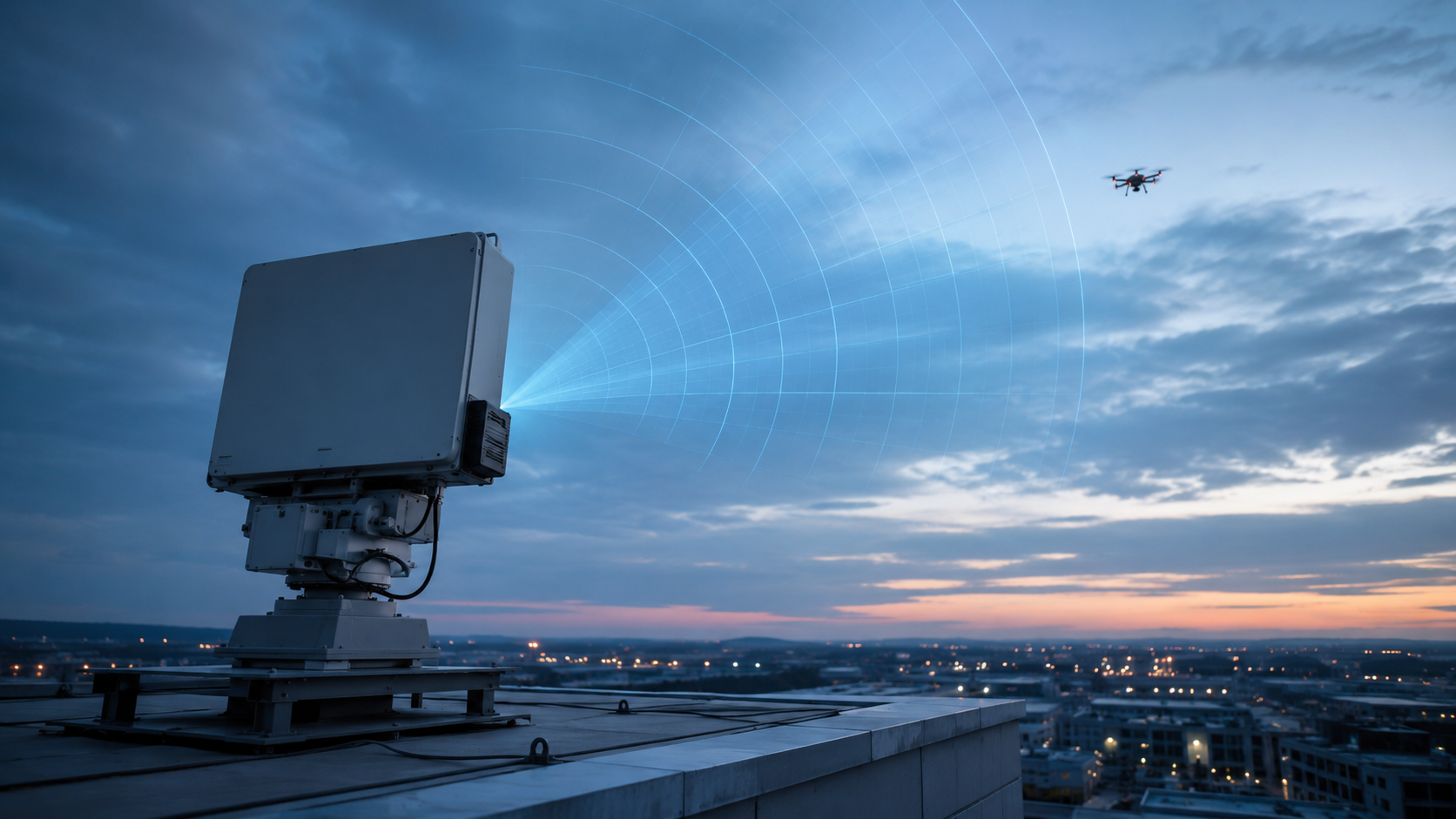
Radar drone detection refers to the use of radar technology to detect, track and monitor drone activity within an operating environment.
Radar can play an important role in counter-drone capability because it may assist with detecting low, slow and small aerial objects, including drones that may not be visible to personnel, may not be broadcasting Remote ID, or may not be detected by some RF systems.
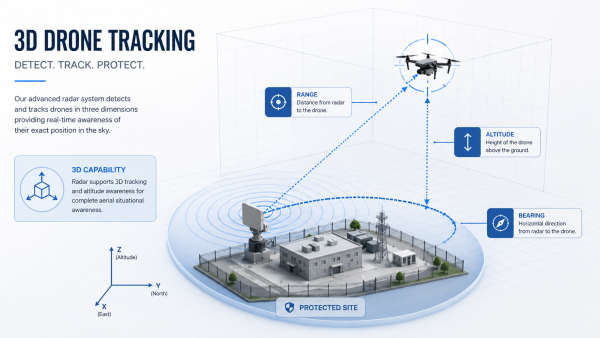
Unlike some RF detection methods, radar may assist with understanding the physical movement of an object through airspace, including range, bearing and, where supported, altitude. This can make radar particularly valuable where three-dimensional tracking, camera cueing, or persistent airspace awareness is required.
Radar should not be viewed as a complete solution by itself. Its effectiveness depends on the operating environment, sensor placement, integration with other detection layers, and the ability to classify or confirm what has been detected.
Where Radar Fits
Radar is commonly used as a detection and tracking layer within a layered counter-drone system. Radar may assist operators to:
• Detect drones that are not transmitting identifiable RF signals,
• Track movement across an area of interest,
• Provide range and bearing information,
• Support altitude or three-dimensional tracking, depending on system capability,
• Cue optical cameras toward a target,
• Improve situational awareness,
• Support command-and-control workflows, and
• Provide detection data for operational reporting and post-incident review.
Radar can be particularly useful where a site requires persistent monitoring, wider-area coverage or detection of drones that may not be visible or RF-detectable.
Types of Radar Drone Detection Capability
Fixed-Site Radar
Fixed-site radar systems are generally used where persistent monitoring is required across a defined area. These systems may be suitable for:
• Critical infrastructure,
• Airports and aviation-related environments,
• Corrections and custodial environments,
• Ports and maritime facilities,
• Government facilities,
• Energy sites, and
• Secure commercial facilities.
Fixed-site radar can support continuous detection and tracking where sensor placement, coverage design and integration with other systems are properly considered.
Portable or Deployable Radar
Portable radar systems may be used where temporary or flexible drone detection capability is required. These systems may support:
• Temporary operations,
• Major events,
• Public safety activities,
• Incident response,
• Short-term site assessments,
• Mobile security operations, and
• Rapidly deployable counter-drone capability.
Deployable radar may be useful where permanent infrastructure is not required, or where a site needs short-duration airspace awareness.
Radar 3D Tracking
Radar systems can provide three-dimensional tracking, including range, bearing and altitude information. This is important because some other detection methods may provide detection or direction information, but not accurate height information.
3D radar may assist with:
• Understanding drone altitude,
• Tracking approach paths,
• Assessing whether a drone is entering a protected zone,
• Supporting optical camera cueing,
• Improving operator situational awareness, and
• Supporting more accurate operational reporting.
Radar and Height Information
Radar can be particularly useful where altitude or three-dimensional tracking is required. A single RF sensor may detect drone-related radio frequency activity, but it will generally not provide the exact location or height of the drone.
Multiple RF sensors may support triangulation or multilateration to estimate horizontal location, but altitude information can be more difficult to determine using RF alone.
Where height, approach path or three-dimensional tracking is operationally important, radar may be required as part of the layered detection architecture.
Operational Benefits
Radar can provide significant operational value because it does not rely on drone communication signals.
Potential benefits may include:
• Detection of drones that may not be broadcasting RF or Remote ID signals,
• Tracking of low, slow and small aerial objects,
• Range and bearing information,
• Altitude awareness where supported,
• Cueing of optical or thermal cameras,
• Improved wider-area situational awareness,
• Support for layered detection architectures,
• Reduced reliance on a single detection method, and
• Improved operational reporting and assessment.
Radar is particularly valuable when combined with optical tracking and RF detection, allowing operators to better understand both the physical location and potential identity of drone activity.
Operational Limitations
Radar should not be viewed as a standalone counter-drone solution. Operational effectiveness may be influenced by:
• Drone size and construction,
• Target altitude and flight behaviour,
• Terrain and buildings,
• Ground clutter,
• Weather conditions,
• Sensor placement,
• Radar field of view,
• Line of sight,
• Reflections and interference,
• False alarms from birds or other moving objects,
• Operator configuration, and
• Integration with other sensor layers.
Small drones can be challenging to detect and classify in complex environments, particularly where there is significant clutter, movement or infrastructure.
Radar may detect an object, but additional layers such as optical tracking, RF detection or Remote ID may be required to assist with identification and classification.
Role in a Layered Counter-Drone System
Radar is often most effective when integrated with other detection and confirmation layers.
A layered system may include:
• RF detection to identify drone control or telemetry signals,
• Remote ID awareness where available,
• Radar to detect and track low, slow and small aerial objects,
• Optical or thermal cameras for visual confirmation,
• Command-and-control software to fuse sensor information,
• Geospatial analysis to understand activity patterns, and
• Operational response procedures aligned to legal authority and risk.
The purpose of layered capability is to improve confidence, reduce false assumptions and provide operators with a more complete operational picture.
Legal and Regulatory Considerations
Radar systems are generally less legally sensitive than active mitigation technologies because they are detection and tracking tools and do not interfere with the drone, pilot, control signal or navigation system. However, their use may still raise governance and operational considerations, including:
• Data collection,
• System logging,
• Integration with security operations,
• Access controls,
• Incident reporting,
• Evidence handling,
• Operator training, and
• Use of collected information for decision-making.
Organisations should consider how detection data will be collected, stored, accessed, protected and used. Counter Drone Solutions does not provide legal advice. Clients should obtain independent legal and regulatory advice where required.